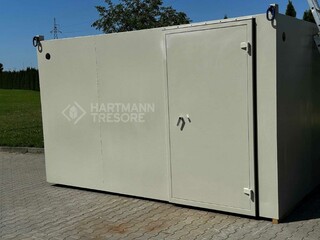
The safe storage of explosives is a key element of security in industry, the military and government institutions. Traditional warehouses often fail to meet stringent safety requirements, which is why blast-proof containers certified to NATO standards are increasingly being used. In this article, we explain why choosing such a solution is the best investment in safety and compliance with international standards.
Reliable protection in a world full of threats
At a time when safety is more valuable than ever before, the blast-proof container is becoming not just a tool, but also a guarantee of peace of mind. This solution is tailored to the armed forces, special services, industrial enterprises and institutions storing explosives, pyrotechnics or particularly sensitive substances.
Our container, designed with military applications in mind, is also ideal as an above-ground backyard shelter. Its robust construction, validated by blast tests, ensures the protection of people against external threats, such as a falling or exploding drone.
This is no ordinary storage facility – it is a fortress designed in accordance with NATO standards (AASTP-1), tested by DNV GL and the Military Technical Institute of Armament at a firing range in Zielonka near Warsaw, guaranteeing maximum resistance to explosions, sabotage and extreme weather conditions.
1. Introduction: What is an explosion-proof container and why is it important?
An explosion-proof container is a specialised storage facility designed for the safe storage of explosives, ammunition and hazardous substances across various industrial and defence sectors. Equipped with a reinforced structure, doors capable of withstanding pressures of 7 to 14.3 bar*ms and advanced safety systems, it guarantees maximum protection for both personnel and the surrounding environment.
The explosion-proof container was developed primarily for the safe storage of explosives, but can also be used to protect people in explosion-hazard zones or in warfare areas. This advanced protective system allows the storage of substances with a high risk of detonation, whilst ensuring the complete safety of personnel (including through air filtration) and infrastructure.
In this guide, you will learn the exact significance of an explosion-proof container, discover why NATO certification is synonymous with the highest quality, and find out, step by step, how to choose the best solution for your organisation. We will also discuss the applicable safety standards and present practical examples of their application.
NATO certificates in the field of international security confirm compliance with the stringent STANAG standards, which guarantee interoperability and the highest level of protection against the effects of an explosion. There are also civilian blast-resistant containers, used in business, manufactured in accordance with the EX Atex directive. However, they do not provide the same level of protection against gunfire or explosions as military containers.
2. Understanding blast-resistant containers: key concepts and definitions
2.1 Basic definitions
An explosion-proof container is a modular engineering structure made of high-strength materials, the primary purpose of which is to protect against the propagation of shock waves and explosive fragments in the event of a detonation or shelling. It differs from an ordinary container by its specialised armour, damping systems and barriers to isolate the effects of an explosion, as well as an air-conditioning and ventilation system that continues to operate even if the power supply is cut off.
Synonyms and related terminology include variations of the English term Blast-resistant container, which in Polish is sometimes referred to as an ‘explosion-proof container’, an ‘explosives storage facility’ or a ‘container with explosion-proof certification’.
Key difference: military blast-resistant containers are designed to provide protection against both external explosions and shelling, as well as against internal explosions in the event that ammunition or other explosives are stored inside the container at the storage site. Resistance to detonation pressure and fragmentation is the primary consideration here. The most important advantage of blast-proof containers is their versatility, both in terms of protection against threats and the protection of materials, infrastructure and personnel.
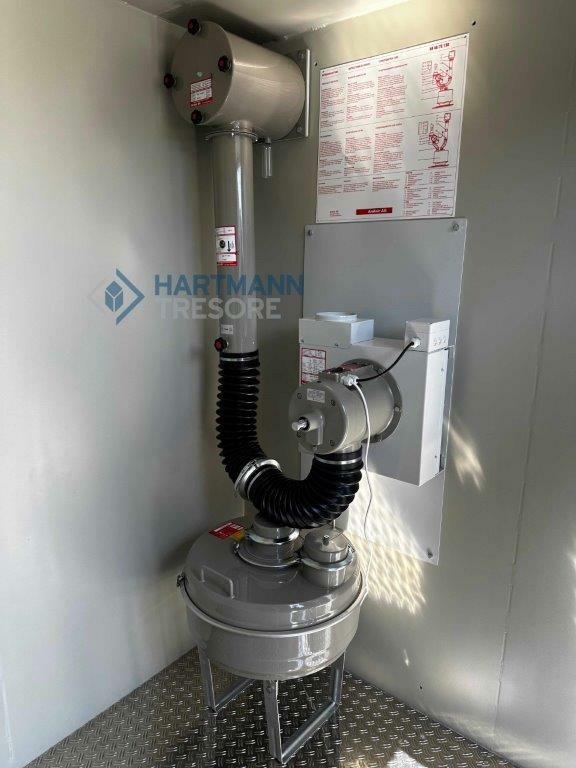
In the case of personnel protection, the container’s autonomous internal ventilation system is of paramount importance, as it allows contaminated air to be filtered even in the event of a power cut.
2.2 Conceptual links
Blast-proof containers form an integral part of comprehensive military or industrial safety systems. The relationship map is as follows:
NATO certificates → International standards → Legal compliance → Operational safety
3. Types of explosion-proof containers
Explosion-proof containers are available in a wide range of designs, allowing them to be precisely tailored to the specific requirements of storing hazardous substances in both military and civilian applications. Depending on requirements, Hartmann Tresore offers containers with one or two compartments: the first – ideal for storing smaller quantities of materials or for the protection of personnel, whilst the second (smaller) compartment serves as a technical room housing systems for passive and active safety, as well as life-support systems; but also simple solutions that enable the efficient use of storage space for larger volumes of ammunition, personnel or substances.
Each type of container is designed to ensure maximum safety and compliance with stringent standards and regulations governing the storage of chemicals and explosives. These structures are made from materials offering enhanced resistance to mechanical damage and the effects of outside factors, which minimises the risk of fires, explosions and the uncontrolled release of hazardous substances.
Thanks to the wide range of available solutions, explosion-proof containers can be used in the defence sector as well as in the chemical and energy industries, and wherever the safe storage of ammunition, chemicals and other high-risk substances is of paramount importance. The choice of the appropriate container type should always take the specific characteristics of the stored materials and the applicable safety regulations and standards into account.
NATO AASTP-1 – safety standards for the storage and transport of ammunition
The application of certified NATO AASTP-1 explosion-proof containers brings measurable benefits, as confirmed by safety statistics.
What is NATO AASTP-1?
NATO AASTP-1 (Allied Ammunition Storage and Transport Publication No. 1) is a North Atlantic Treaty Organisation publication which sets out uniform safety standards for the storage and transport of ammunition and explosives. It is a key document for all NATO member states, and its aim is to minimise the risk of accidents and ensure common procedures in peacetime.
Why is AASTP-1 so important?
The safe storage and transport of explosives are fundamental to the operation of modern armed forces. AASTP-1:
- • defines safety distances (Quantity-Distance, QD) between ammunition depots, buildings and civilian infrastructure,
- • provides guidelines on the design and construction of ammunition bunkers,
- • sets out procedures for the loading, unloading and transport of ammunition,
- • outlines methods for mitigating the effects of explosions and protecting personnel.
As a result, all NATO countries operate according to the same rules, which is particularly important in the case of joint bases, multinational operations and overseas missions.
AASTP-1 and other NATO publications
AASTP-1 is not the only document in this series. For example:
• AASTP-5 focuses mainly on the transport of ammunition by land,
• other NATO publications explore issues related to the storage of hazardous materials under various operational conditions.
Together, they form a coherent system of safety standards applied by all allied forces.
Who uses AASTP-1?
The publication is used not only by the armed forces of NATO member states, but also by:
• institutions responsible for military logistics,
• defence contractors and ammunition suppliers,
• training centres,
• international organisations cooperating with NATO.
Summary
NATO AASTP-1 forms the foundation of safety in the storage and transport of ammunition. Thanks to these uniform rules, the Alliance can conduct joint military operations efficiently and safely, whilst risk associated with explosive materials is minimised.
Key economic benefits:
• estimated average cost of an accident involving the explosion of hazardous materials: PLN 2–15 million,
• cost of investing in a certified container: EUR 200,000–250,000,
• return on investment: achievable after preventing just one serious incident.
The containers can be fitted with a variety of safety systems and additional features, such as ventilation or monitoring systems. It is also possible to equip the containers with special pockets for mounting components, such as forklift forks, which enhances safety and stability during transport.
We also recommend: Explosion-proof armoured doors for weapons and ammunition storage facilities
4. Technology that protects lives and property – key specifications of the Hartmann Tresore explosion-proof container
A door that no force can breach
• construction with a resistance rating of 7 bar and 14.3 bar*ms,
• locked with heavy bolts and a dual double-bit key lock,
• sturdy handles and a protective lock cover,
• airtight weather seals protecting the interior from moisture and dust,
• solid hinges guaranteeing many years of trouble-free operation.
This door is more than just an entrance – it is a barrier that neither an explosion nor a burglar can breach.
A design built for extreme conditions
• storage area: 8.6 m²,
• technical room: 8.5 m²,
• option to customise dimensions to suit individual needs,
• separate mechanical space – full control over safety systems,
• loading ramps and SS3021 stainless steel hooks (Swedish Standard – Svensk Standard) – quick relocation and ergonomic handling.
From desert heat to Siberian frosts – the container operates without disruption at temperatures ranging from -35 °C to +50 °C. It is also fitted with protective covers and a rainproof roof, which guarantee complete resistance to rain, snow and wind.
Smart security systems
The interior of the container is not just a storage space – it is a premium-class security centre:
- • burglar alarm and video surveillance system,
- • air conditioning and dehumidification – full control over indoor conditions,
- • explosion-proof valves and bushings in every wall feed-through,
- • emergency passageway between rooms – additional protection for staff,
- • a power generator ensuring energy independence,
- • an autonomous air filtration system in the event of a power cut,
- • LED lighting for safety and comfort at work,
- • non-slip flooring.
Every component of this system has a purpose and contributes to the comprehensive protection of personnel and stored materials in hazardous situations. For example, the loading ramp enables rapid loading and evacuation of the container from the hazard zone, whilst the system of solid doors, bolts and locking mechanism ensures full operational capability even after an explosion.
Uncompromising user comfort
Safety does not preclude comfort. Non-slip flooring, an ergonomic arrangement of the rooms and the option of full customisation of dimensions and fittings make the explosion-proof container a solution tailored to your needs.
The container can be successfully used as a shelter (with an air filtration system) or as temporary refuge for people in the event of a critical situation.
Would you like to add further access control systems? Or perhaps enlarge the technical room? Every detail can be tailored to the user’s requirements.
Why choose our explosion-proof container?
✔ Meets international NATO standards – a guarantee of quality and reliability.
✔ Resistant to explosions, break-ins and sabotage – safety confirmed by testing.
✔ Operates in extreme climatic conditions – from -35°C to +50°C.
✔ Up-to-date technical systems – monitoring, alarm, air conditioning, power generator, and a mains-independent air filtration system.
✔ Mobile and flexible – easy to transport and fully customisable.
Applications of the explosion-proof container
- • storage of explosives and ammunition at military bases,
- • storage of pyrotechnic materials in the events and film industries,
- • securing chemical and hazardous substances in industrial plants,
- • protection of critical infrastructure, laboratories and strategic facilities,
- • shelter or temporary refuge for personnel.
5. Step-by-step guide: how to choose the proper explosion-proof container?
Step 1: Identifying needs and legal requirements
Before selecting a container, it is essential to carry out a detailed analysis based on the following points.
Requirements checklist:
• type and quantity of materials to be stored,
• maximum TNT equivalent mass planned for storage,
• temperature requirements (typically -35°C to +50°C),
• location and environmental conditions (safety distances, foundations).
Legal requirements in Poland include:
• a permit for the storage of explosives,
• certificates of compliance with STANAG standards,
• technical documentation for the security system.
Step 2: Selecting a container with the appropriate certificates
Verification of NATO STANAG certificates:
1. Check the certificate number in the NATO database.
2. Confirm compliance with NATO-AASTP-1 (storage and transport of ammunition).
3. Verify fragmentation resistance tests.
Recommended equipment:
• an automatic heating and ventilation system,
• an autonomous ventilation and power supply system,
• lighting,
• explosion-proof valves and cable bushings.
Step 3: Installation and safety monitoring
The installation process requires:
• depending on the substrate, a concrete foundation or concrete slabs,
• maintaining safe distances from buildings,
• connecting alarm and monitoring systems,
• training staff in operation and safety procedures.
Measures of success:
• zero incidents related to leakage,
• 100% efficiency of safety systems,
• compliance with the technical inspection schedule,
• temperature stability inside the container of +2 °C.
6. The most common mistakes when selecting an explosion-proof container
Mistake 1: Selecting a container without NATO certification
Products without NATO certification do not guarantee compliance with international safety standards and may not be accepted in multinational operations.
Mistake 2: Underestimating storage capacity
Exceeding the TNT equivalent limit for a single container breaches safety regulations.
Mistake 3: Ignoring location requirements
Incorrect placement of the container may put surrounding buildings and infrastructure at risk, as well as result in legal sanctions.
Expert tip: Always consult certified explosives safety specialists when making your selection, and do not skimp on technical consultations before purchasing.
7. Frequently asked questions about explosion-proof containers
Q1: What is the difference between an explosion-proof container and a fire-resistant one?
A: Explosion-proof containers are fitted with steel armour and shock-wave suppression systems, whilst fire-resistant containers primarily protect against the effects of high temperatures and fire from outside. Fire-resistant containers provide defence against fires, but not necessarily against the effects of an explosion.
Q2: How much does a NATO-certified explosion-proof container cost?
A: Prices start at EUR 150,000 for basic models and can exceed EUR 300,000 for large-capacity military containers, depending on the equipment and certification.
Q3: What are the requirements regarding the container’s location?
A: The minimum safety distances are 50 metres from residential buildings; a foundation or concrete base is required, and fire safety standards must be complied with in accordance with national regulations.
8. Summary: explosion-proof containers – an investment in safety
An explosion-proof container is more than just a product. It is an investment in peace of mind, safety and reliability. Designed to withstand what other structures cannot. It guarantees that even in the face of the greatest threat, your assets remain fully protected.
5 key points to remember:
- NATO certifications guarantee the highest level of security and compliance with international standards.
- A maximum capacity of 50 kg of TNT equivalent per container ensures safe storage.
- High-strength steel armour with special filling provides essential protection against fragmentation and pressure wave.
- Compliance with STANAG-AASTP-1 enables use in multinational operations.
- Investing in certified solutions pays for itself by preventing costly accidents and ensuring legal compliance.
Next step: Contact certified experts, download a detailed product catalogue and arrange a consultation on selecting the right container for your organisation. Remember that choosing a NATO-certified blast-resistant container is an investment in safety that protects not only materials, but first and foremost people and the environment.
🔒 Invest in safety without compromise.
📞 Contact us today and discover our range of explosion-proof containers tailored to your needs.
By using professional storage solutions, it is possible to maintain full control over risks and ensure operational stability across various industries – from the defence sector to the chemical and energy industries.