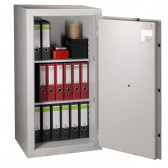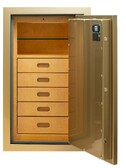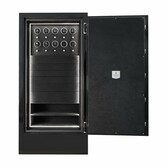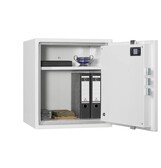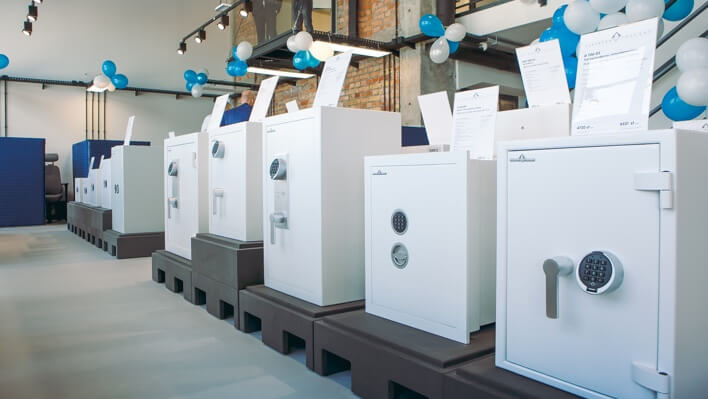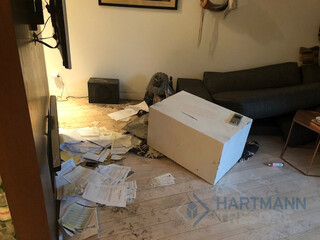
In its online edition of 15 April 2025, Rzeczpospolita reported that: ‘a safe containing 4 million zlotys fell prey to burglars’. The safe contained, among other things, diamond jewellery, cash and expensive watches. The safe and its contents were stolen from a flat in the centre of Warsaw, located on the ground floor of a building. Do you want to secure your valuables? In this article, we explain why the customer lost so much money. Is it still worth having a home safe despite such incidents? How do you choose the best home safe? And what should a safe be like to withstand a break-in and theft? This article is a must-read for anyone facing the choice of the right safe for their home. We’ll also discuss the different types of safes in this article. Read on!
Key information
• A well-considered investment in a home safe enhances the security of valuable items, protecting them not only from theft but also from fire.
• Types of safes, such as freestanding, wall-mounted and floor-mounted safes, offer different levels of security and should be tailored to the individual needs of users and, above all, to the value of the items stored within them.
It is worth choosing heavy safes with VdS or ECB-S security certifications and appropriate locks, fitted with an alarm system, and mounting them to structural elements in the home to secure stored items such as documents, jewellery and cash.
What links cases of burglary and safe theft in houses?
Before we move on to which home safe to choose to prevent theft in a situation like this, let’s look at the details of this case and draw some conclusions.
Location – what to look out for?
The article states that the burglary and theft took place ‘in a private flat on a small street in a prestigious location – in the area of Saski Garden’ in Warsaw while the owner was away.
Conclusion: If you live in a prestigious, upmarket area, in a townhouse in the city centre, in an exclusive housing estate or in an expensive neighbourhood, or in the villa-lined suburbs, you are more at risk of burglary and theft than residents of ordinary suburban neighbourhoods. Why? Because thieves expect to find more money, valuables or other precious items in your house that they can easily monetise.
In such locations, there is often a higher level of criminal activity specifically targeting the houses and flats of wealthy individuals. Thieves are aware that the risk is greater, but the potential rewards outweigh the risks for them. That is why, in these areas, it is particularly important to ensure robust security measures, including a high-security home safe, installed in such a way that it cannot be easily removed or forced open.
Furthermore, in such areas, additional security measures are often employed, such as CCTV, alarms or physical security, which, when combined with a suitably chosen home safe, can effectively deter potential burglars.
In summary, location is of key importance to the risk of burglary and theft, so when choosing a home safe, it is worth taking the specific nature of your home into account and tailoring security measures to your individual needs and risks.
Reconnaissance of the burglary site
Burglars, according to the investigators handling the case, did not act blindly, but had carried out thorough reconnaissance. They knew the owner was a wealthy man; perhaps they knew he had a safe. Before carrying out the break-in and theft, they most likely observed the property. In such situations, the police routinely check third parties who may have recently visited the property, for example in connection with cleaning, repairs or renovations.
Conclusion: Before you are robbed of jewellery, money or other valuables, thieves will have been watching you beforehand, tracking you on social media; they know your habits, when you are not at home, what car you drive, and many other details. Do not underestimate this.
Thieves rarely act spontaneously or by chance. A burglary involves a huge risk for them – they face a prison sentence of between one and ten years (article 279 of the Criminal Code). In the case of repeat offences or the theft of property of significant value, the sentence can be as long as 20–25 years (article 294 of the Criminal Code). That is why they try to minimise risk whilst maximising their profits. One could say that the Pareto principle applies to them too: 20% of burglaries yield as much as 80% of the profits, which is why they focus on the most lucrative cases. This gives them more time to explore the area (a task aided by modern technology) and to prepare for the burglary, as well as to choose the right moment to gain access to the scene of the crime safely and without difficulty.
Be careful who you let into your home – in many cases, such as the one described below from Gorzów, burglaries are carried out by people known to the victims, such as a cleaner or a maintenance worker. Even if they do not steal themselves, they may pass on or sell information to thieves.
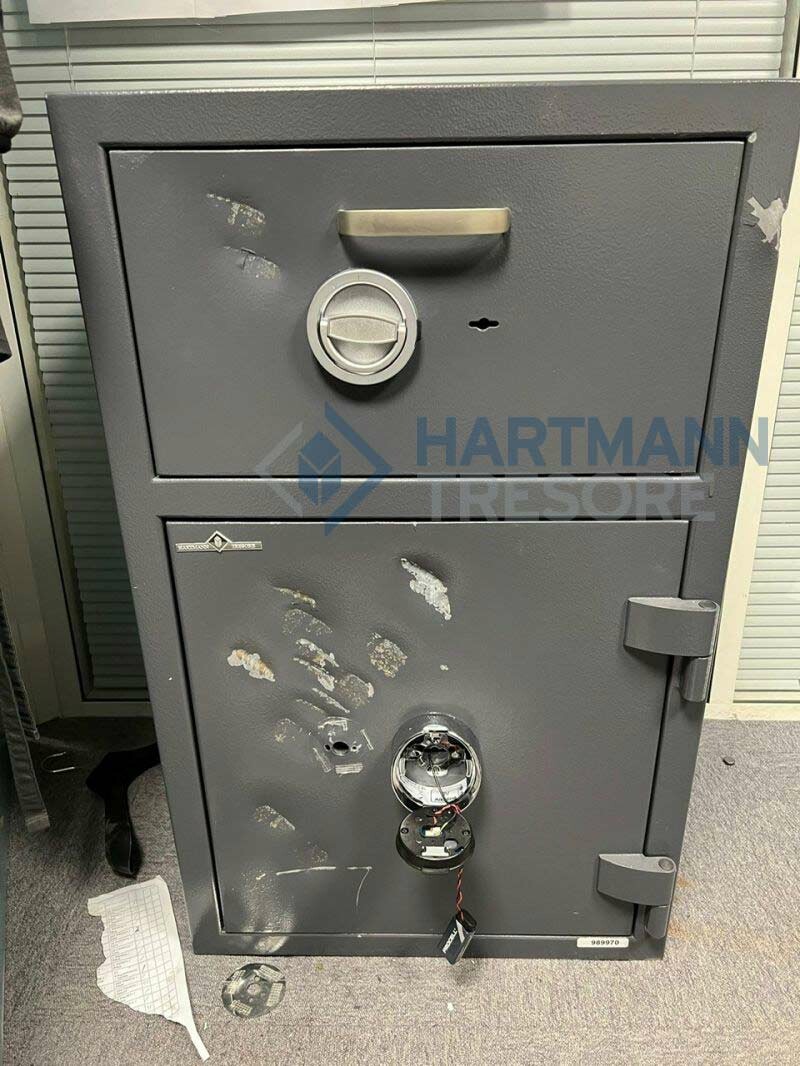
One of Hartmann Tresore’s customers only decided to purchase a sturdy safe after two expensive collector’s watches were stolen from his upstairs bedroom during a burglary. Interestingly, the thieves, encouraged by the easy haul, tried to break in again, but this time they hit a snag – they only managed to damage the outer casing of the safe, which they were unable to open.
Opportunity makes the thief – ground floor
Furthermore, as reported by Rzeczpospolita: the safe was stolen from a flat on the ground floor of a block of flats, and the burglars gained entry via the terrace by prying open the patio doors.
Conclusion: You must take particular care to ensure security in the case of detached houses or flats located on the ground floor or first floor. It is more difficult for burglars to gain access to flats on higher floors, although break-ins do occur there too. Easy access, unsecured patio doors, open windows, the absence of an alarm system, or the lack of vigilant neighbours who are aware of your absence often lead to attempted break-ins. Remember that your safety depends on many factors. If you are concerned about your property, try to deter burglars from attempting a break-in effectively by making it difficult for them and increasing the risk. It is worth taking care of lighting with motion sensors, burglar-proof windows, shutters and doors, an alarm system, and asking neighbours to be vigilant. Additionally, invest in a sturdy home safe. If you keep valuable items at home, such as collectibles, designer watches or works of art, it is also worth considering purchasing a monitoring service from a professional security agency. A small monthly subscription fee is a minor cost compared to the loss of several million zlotys...
They took the safe, and 4 million zlotys with it
As reported by Rzeczpospolita, the thieves, having gained entry, ransacked the flat and took the home safe found inside with them, which not only contained cash and jewellery but also expensive designer watches. The owner valued the total loss at the aforementioned 4 million zlotys. According to investigators, the thieves entered the flat silently and left in the same way – nobody, including the neighbours, noticed or heard anything. The theft was only discovered by the owner upon his return after a two-day absence from home.
Conclusion: force potential thieves, when entering your home, to make a noise, as this alone may scare them off and, in any case, put additional pressure on them. In the situation described above, the thieves were not only able to enter quietly, but also had very comfortable conditions in which to ransack the entire flat; they took valuable items from it and left with the safe without being noticed by anyone. Note that the police report does not mention a break-in to a home safe, but rather the theft of the safe along with its contents. And this brings us to three key conclusions from the perspective of Hartmann Tresore – a safe manufacturer:
1. These were not professional safecrackers, as they would have tried to open the home safe on the spot, yet they took only the valuable items from it.
- 2. The safe was very light, since two people, unnoticed and unalerted by anyone, managed to carry it out of the house along with its contents, without making any noise or alerting anyone. Most likely a mass-market product, or a small safe bought from an online shop, with a low burglary resistance rating, offering only illusory protection against theft by brute force.
- 3. Thirdly, the home safe was most likely sitting on a shelf in a wardrobe or dressing room and was not fixed in place. And even if it was fixed in place, it was done so ineffectively (to plasterboard) or its low weight allowed the fixing bolts to be easily torn out, which in turn would have caused a noise, so this is unlikely.
Stories similar to the one above are reported by newspapers and online portals across the country. For example, in its online edition of 18. June 2025, Gazeta Lubuska reported that a safe filled with cash and jewellery worth a total of a quarter of a million zlotys had been stolen in Gorzów Wielkopolski.
In this case, it turned out that the thief knew the victim. Cases similar to these are appearing more and more frequently in the headlines of websites and newspapers across the country. Why?
Cash is king
In recent decades, Poles have benefited from the political transition and have begun to grow wealthy rapidly. The growth of Poland’s GDP is attracting attention and recognition worldwide. It also translates into the wealth of our country’s citizens, a significant proportion of whom have accumulated savings and substantial financial reserves, including in foreign currencies.
We are also buying more and more gold, jewellery and expensive branded automatic watches. It is understandable that, for various reasons, we keep some of these reserves and assets at home. We enjoy admiring our collections in our spare time, and crisis situations such as the Covid-19 pandemic, the blackout in Spain or the war in Ukraine show that despite the rapid rise in cashless payments, cash becomes essential for normal functioning in critical situations.
However, in light of the thefts described above and the occurrence of crises where cash is often essential, our customers frequently ask us: Is having a safe at home a good idea? Are home safes really secure? What is the best safe for the home? What is the most secure safe? Which cash safe should I choose? Where should I place the safe in my home? We will attempt to answer these and other questions later in this article.
Does it make sense to have a safe at home?
Before answering this question, let’s take a look at all the factors affecting the security of our property, based on the cases described above.
The media report on situations similar to those described in the article quite frequently, and they all share one common factor:
• observation or familiarity with the victim,
• absence from home and a lack of, or insufficient, burglar-proof security measures,
• as well as a safe that can be quickly carried out of the flat along with its contents, whilst remaining completely unnoticed.
Since we have no control over whether, when or by whom we are being watched, and since we sometimes leave our homes for extended periods, e.g. when going on holiday or on business trips, let’s focus on the only element we can influence – the safe itself and other security measures.
Are home safes really secure?
If you’ve read this far, you’re probably wondering if this makes sense? After all, the victim had a safe, yet still lost 4 million. He had a safe... that two people could carry away. This is certainly not the sort of safe you can leave unattended – see the famous film Home Alone.
Besides, if we take the risks seriously and care about the security of our home, we should treat the purchase of a safe as part of a broader strategy to deter thieves. Securing and protecting cash, jewellery, designer watches, gold bars and other valuables or documents kept at home against theft requires careful thought, a plan and a comprehensive security strategy, often right from the stage of building or furnishing the house.
Since getting hold of a safe is the crowning achievement of a burglary for thieves (after all, that is where the most valuable items are kept), you must ensure that it is properly secured. Why? Let’s use a chess analogy. You don’t place your king on the front line, but you do castling to hide and defend him against attacks. The king is the most important piece in chess, and all the other pieces on the board serve to protect him – you move the rook to block access to the king. You need to apply a similar strategy to protect your safe from theft.
Where is the best place to hide a safe at home?
There are plenty of options. And the more creative your approach to the matter, the better for the owner. During the construction phase, you can plan for a hidden recess, the construction of a safe room, or a reinforced concrete basement with an armoured door, in which to install a home safe. You can also plan for a special hiding place in which to conceal the home safe. We can hide the safe in a wardrobe, behind a cupboard in the kitchen or in a walk-in closet. If you have thick walls, you can install a wall-mounted safe.
Ideally, only the homeowner or their closest family members should know about the safe at home. The fewer people, the better. At Hartmann Tresore, we often provide our customers with a special service known as discreet delivery. We carry this out in such a way that none of the neighbours know we are delivering a safe.
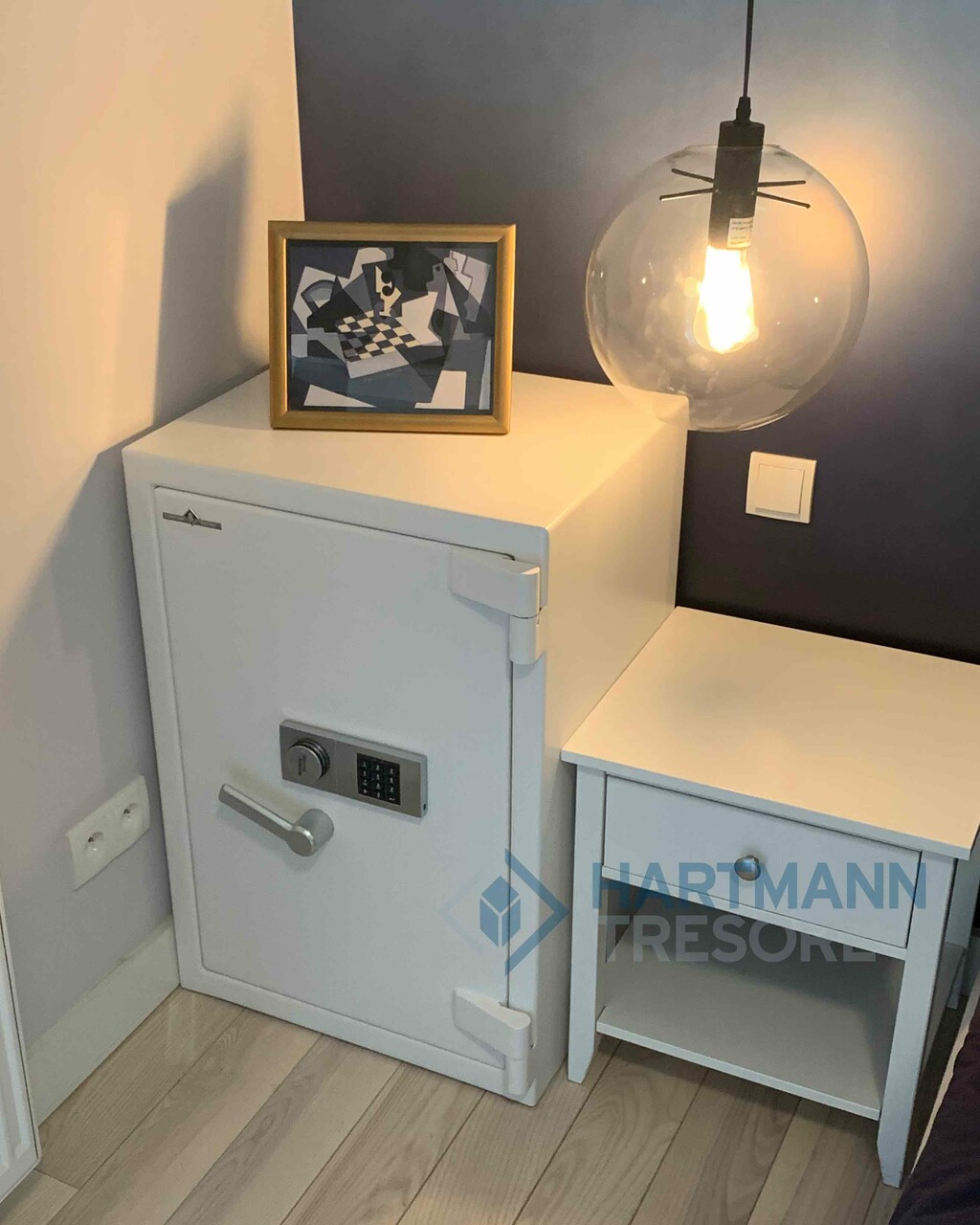
However, there are home safes that are so secure and aesthetically pleasing that there is no need to hide them. On the contrary – they are often made to order, with an elegant glossy or matt finish and the interior is lined with solid wood and alcantara, fitted with watch winders, special compartments for jewellery and other accessories. Such safes not only do not detract from the interior, but actually add to its prestige. However, do not be fooled by their appearance – beautiful on the outside, but true beasts on the inside. They weigh several hundred kilograms, have thick, armoured walls, advanced internal security features, are firmly anchored to the floor and are not affected by the owner’s absence. They can effectively resist burglars. At the customer’s request, they can be connected to a home alarm system. They can withstand a great deal, and moving them is extremely difficult – a professional team of 4–6 people needs anywhere from a few to over a dozen hours, often using specialist equipment.
Remember that a safe is an important element of a security system, but only one of many. If burglars have easy access to the house, they may spend a lot of time overcoming other security measures. In such a situation, it is worth considering replacing the door, installing an alarm, securing the windows, and placing a modular vault in the garage or basement. Furthermore, it is extremely important to choose a home safe with an appropriate burglary resistance rating, one that will be difficult for potential thieves to break into. Finally, it is also worth considering taking out insurance for items stored at home and kept in the safe. Insurers often require information about the safe’s certificates and rating.
What does this mean for the average user? Plainly speaking: if you keep 4 million zlotys at home, it is worth investing in a safe whose security features are commensurate with the value of the assets stored. That is why our advisers always ask customers about the value of the deposit they intend to place in the safe. Had the property owner from the article cited at the beginning opted for a safe costing around 1% of the funds stored, they would still have at least 3,960,000 PLN at home today.
Are home safes secure? Definitely yes, as our experience confirms. Hartmann Tresore Polska has been operating in the market since 2002, supplying tens of thousands of home safes to protect valuable items. We have recorded unsuccessful break-in attempts at some customers’ properties. Whenever a customer takes security seriously and consults our advisor, we find a solution perfectly tailored to their needs. Many of our customers return to us for further home safes. We encourage you to contact us to find out how to choose the safe that suits your requirements best.
Perhaps two home safes?
Another very interesting security strategy is to install two safes in the house. One of them is usually small and easy to find, containing a modest sum of money. This is a lightweight, non-fixed safe that can be quickly carried off (it’s better if thieves, satisfied with their haul, leave quickly and don’t cause any damage), whilst the other is sturdy and well-hidden. At Hartmann Tresore, we also have a special safe, the so-called Ghost Safe, which combines both these functions in a single robust design.
Such a strategy can prove effective during a burglary or a so-called armed robbery, when the owner and their family are at home and are forced by the attackers to hand over their valuables. In such a situation, we can also defend ourselves effectively. Home safes can be fitted with a special feature, the so-called silent alarm and delayed opening. This means that if the safe is forced open by intruders, we can alert security discreetly and unnoticed, without putting ourselves or our family members in danger. Fortunately, such situations are extremely rare in Poland.
Not just burglary
When planning to invest in a sturdy safe, it is worth considering other risks as well. Statistically, fire is a more common threat than burglary. In early July 2025, the media reported on a tragic fire in a residential building in Ząbki, near Warsaw. It is therefore worth taking a closer look at fire-resistant safes, which, in addition to theft, also protect the items stored within them from high temperatures and fire.
This is particularly important when storing documents, cash (after all, paper is the carrier of money) and other valuable items, to minimise the risk of their loss or destruction, for example during a fire. Whilst most documents can be reproduced, this may prove difficult and very costly, and in some cases impossible. It is also good to remember items of sentimental value, such as old photographs, which we may lose forever.
Summary
Are home safes really secure? If we meet the right criteria, then yes – safes do provide security!
Below you will find a checklist to help you choose the right safe for storing documents, cash and other valuables at home:
1. What threats do you want to eliminate effectively? Are you looking for protection against burglary, fire, or perhaps both?
- 2. What is the total value of the items you plan to store in the safe?
- 3. How many of these items are there, and in what form will they be stored? What should be the internal capacity of the safe?
- 4. Where do you plan to install the safe? Should it be concealed, or perhaps freestanding, serving as a decorative feature in the interior? What is the maximum load-bearing capacity of the ceiling at the installation site? Should the safe be anchored to the floor or to the wall?
- 5. Should the safe be equipped with additional features, such as: an alarm system, watch winders for automatic watches, jewellery drawers, interior lighting, etc.?
- 6. Finally: what type of locks do you want to use on the safe? Electronic locks? Key locks?
Fire-resistant safes, fitted with electronic or fingerprint locks, guarantee quick and convenient access whilst protecting against unauthorised opening effectively. The safe should be installed securely and permanently, preferably to a wall or the floor, making it difficult to remove from the room.
Modern home safes, thanks to their robust construction and advanced security features, provide effective protection against attempted break-ins and other threats, such as fire or water damage during firefighting.
One must not forget about regular maintenance and proper operation of the safe, which helps maintain its reliability and long-term effectiveness. It is also important that household members are familiar with the rules for using the safe, which prevents accidental damage or loss of access to stored items. In this way, well-planned and professionally installed safeguards, including home safes, form an essential part of protecting the house and property against various hazards.