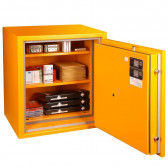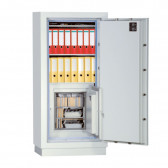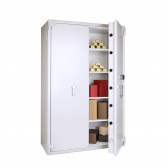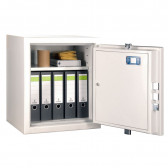
Having a secure home safe is not only a way to protect valuable items, but also an investment in peace of mind and the certainty that our most precious belongings are properly secured. In today's uncertain times, when threats such as theft and fire are becoming increasingly common, a sturdy home safe is an indispensable piece of equipment in every home. Safes are playing a key role in protecting property from burglary, fire and other threats increasingly, and their popularity is steadily growing.
What are the most important features of home safes?
The choice of the right home safe should be based on individual needs and the nature of the items stored, taking their size, volume and susceptibility to various hazards, such as fire, into account. There are a variety of models available on the market – from compact safes for storing documents, valuable jewellery or high-value items, through safes for weapons, to larger burglar-proof safes designed to secure cash, designer watches or gold. Fireproof home safes are also becoming increasingly popular, enabling the secure storage of digital media (such as memory drives or LTO tapes) and weapons, offering effective protection against both theft and burglary. When choosing a safe, it is worth paying attention to features such as solid construction, which is reflected in a high weight, an appropriate burglar-proof grade (from the lowest S1, through S2, 0, I, II, III, IV, V, VI, VII – the higher the class, the better the protection), the type of lock used, the quality of materials and additional features that increase security and comfort of use.
Thanks to a safe equipped with modern technologies, such as an electronic or biometric lock, opening by a mobile application, connecting the safe to an alarm system, we have the possibility of quick and secure access to the contents, while minimising the risk of unauthorised opening. In the case of electronic locks and opening the safe from an app, it is possible to add multiple users, which increases flexibility and access control. All certified home safes available on the market also have mounting holes that allow them to be permanently fixed to the floor or wall, which provides additional protection against attempts to carry the safe away by a potential burglar. The installation of safes weighing less than 1000 kg is not only a necessary requirement for certification but also common sense. A lightweight and unsecured home safe will certainly be stolen with all its contents during a burglary. Lightweight home safes can be useful for securing deposits from unauthorised persons in situations where the risk is low. They work well when under constant supervision by household members or office staff. However, they are not suitable for being left unattended, for example when you are away from home on holiday.
It is worth remembering that buying a home safe is an investment for years to come, so when choosing a good home safe, you should consider high resistance classes and safe features, as well as pay attention to its certificates, reviews from other users and listen to the advice of experienced customer advisors who have been working at Hartmann Tresore for many years. Their knowledge and experience can prove invaluable in a crisis situation. When you lose money, you can usually work it off or recover it in some other way (insurance), but the loss of unique, priceless souvenirs – things that cannot be replaced – is often a more painful loss than a financial loss. Properly secured valuables in a carefully selected safe will be protected not only against theft, but also against other threats, such as fire or water used to extinguish it.
In summary, having a home safe is an effective solution for protecting your valuable items and documents.
Why is it worth investing in a home safe?
Investing in a home safe is a step towards increasing the security of our property. A home safe protects your most valuable items from theft, which is one of the main reasons why it is worth having one. With the number of burglaries on the rise (the press recently reported the theft of a safe with contents valued by the owner at 4 million zlotys), having a safe can significantly minimise the risk of losing valuable items. A home safe is also an excellent place to store precious items, papers and other valuables, as well as objects of great sentimental value.
In addition to protection against theft, some home safes on offer also ensure protection against fire. Important documents, jewellery or cash can survive even at a temperature of 1090 degrees Celsius for up to 24 hours if stored in a fireproof safe. Tests simulate a 1- or 2-hour fire, the collapse of the building structure and the persistence of high temperature in the building ruins for up to 24 hours. Thanks to this, even in the case of a serious fire, our valuable items, including stored documents and precious jewellery, will remain intact.
A home safe is an investment that provides adequate protection for many years, guaranteeing the safekeeping not only of your property, but also of your precious memories.
Types of home safes
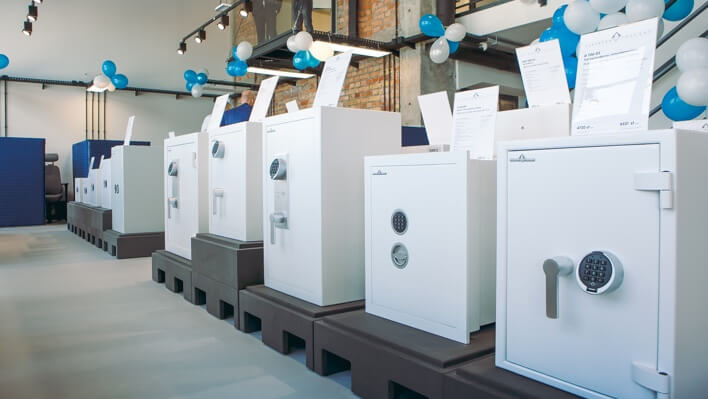
There are various types of home safes available on the market that can be tailored to the individual needs and requirements of customers. The most popular ones are free-standing safes, wall-mounted, furniture and floor safes. Each product can be adjusted to the specific expectations of a customer.
Each of these types has its own unique advantages and specifications, allowing you to choose the best solution in different configurations depending on your requirements and conditions.
Free-standing safes
Free-standing safes are very popular due to:
● ease of installation,
● flexibility in placement, as they can be placed in virtually any room, making them very convenient,
● availability in various sizes and configurations, allowing them to be tailored to the individual needs of users.
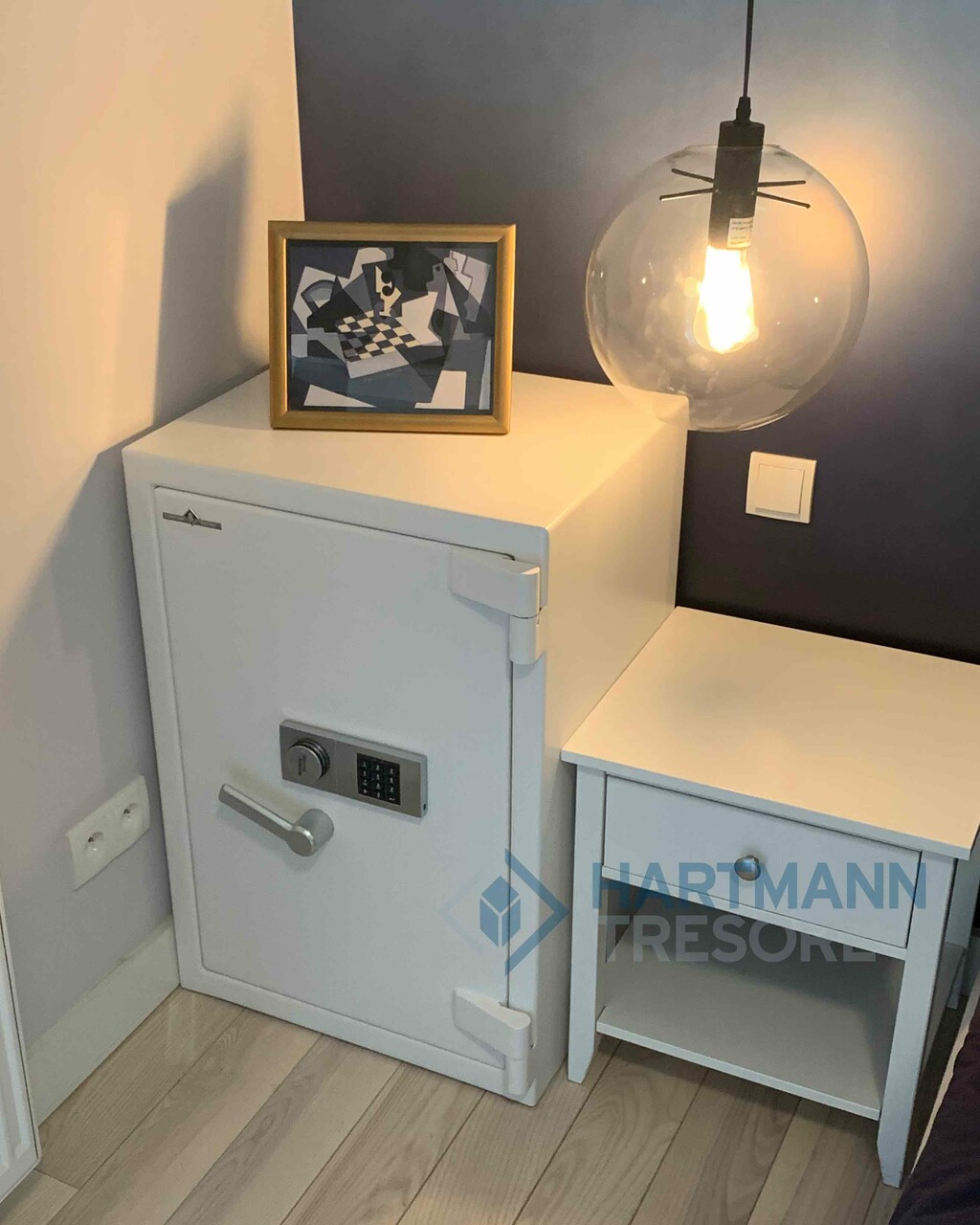
Thanks to their robust construction, free-standing safes offer the highest level of protection against attempted break-ins in the above-mentioned typology. Many of them are equipped with modern solutions, such as electronic lock or alarm system, providing additional security and easy access to the contents. They are the ideal solution for people who want to secure their valuable items quickly and conveniently. Depending on your needs, you can also choose a compact safe for smaller spaces.
Wall safes
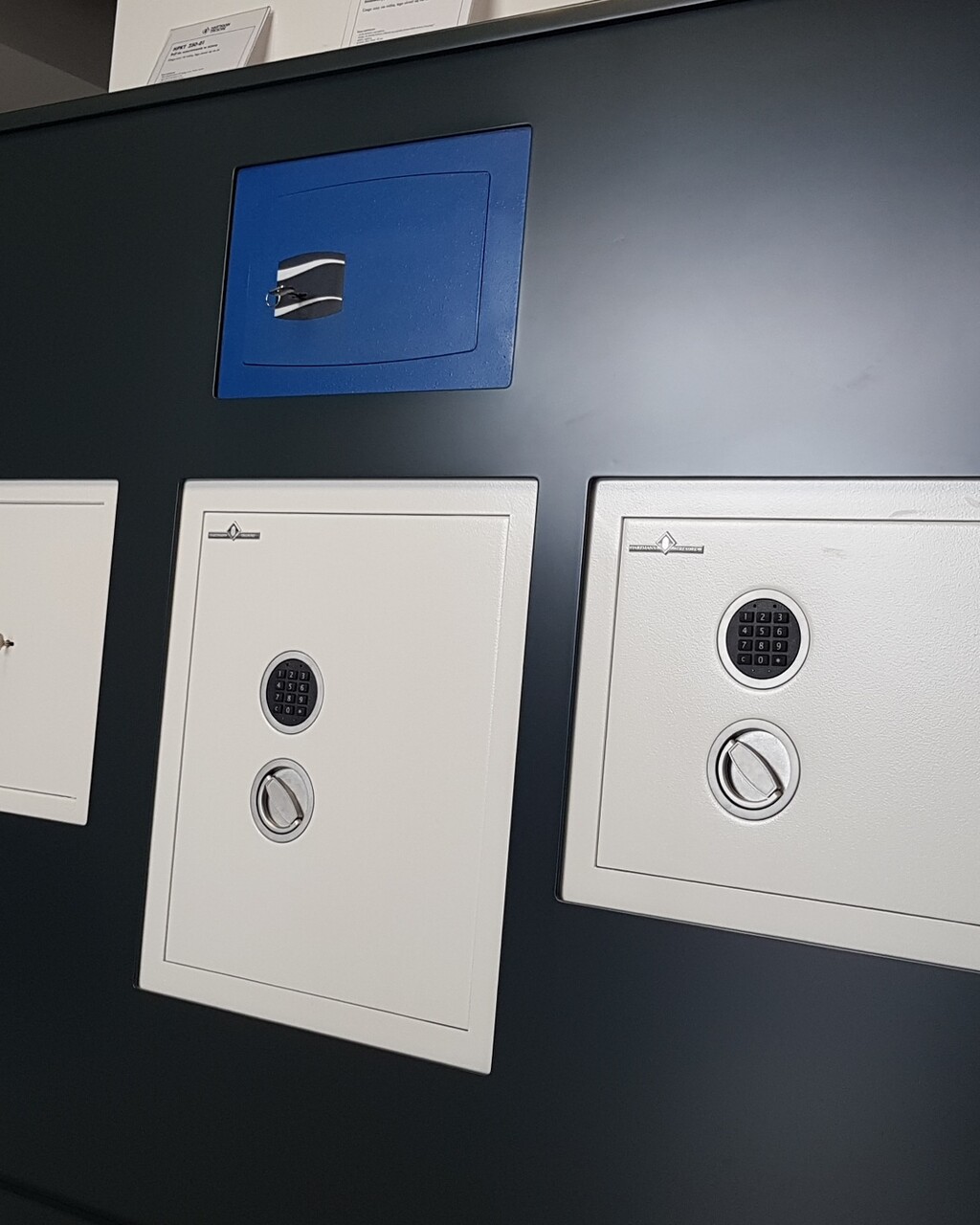
Wall safes are an excellent choice for people who value discretion and security. Installed in walls, they are invisible and difficult to detect by potential thieves. Although their installation can be more complicated and requires the preparation of a suitable opening in the wall or a special recess, they provide a relatively high level of protection for valuable items.
Wall safes are best for storing money, jewellery and small valuables. Because they are hidden in the wall, they are more difficult for thieves to find and break into, making them the ideal solution for those who want maximum protection against theft. It is worth paying attention to the type of lock – wall safes can be opened with a key or a code, and it is important to keep the keys in a secure place to maintain access safety. In some situations, the disadvantage of wall safes may be the lack of adequate fire protection.
Floor safes
The biggest advantage of floor safes, like wall safes, is that they are difficult to find, although they offer a moderate level of security compared to free-standing safes. Installed under the floor, they are virtually invisible.
Investing in a floor safe pays off in the form of additional security for our valuable items.
Thanks to their design, floor safes are the ideal solution for people who want to maximise the security of their valuables, such as jewellery or cash, against burglary and theft.
Furniture safes
Furniture safes are lightweight burglar-proof safes that are popular among residents of multi-family buildings. They are most often installed in wardrobes, which explains their name. They are chosen by families who employ nannies or cleaners, as their primary purpose is to protect cash, documents, car keys and other valuable items from unauthorised access, not necessarily to prevent burglary. Due to their light construction and low weight, they are not suitable as a main home safe. In the event of a burglary, thieves often take such safes with them without opening them on the spot. If you live in a detached house or an unguarded multi-family building, we recommend choosing a more robust safeguard. Our customer advisors will be happy to help you choose the right solution.
How to choose the right home safe?
Choosing the right home safe can be challenging, but a few key aspects can help you make the right decision. First of all, it is worth paying attention to safety certificates. Only safes with certificates issued by VdS or ECB-S according to the PN-EN 1143-1 standard ensure high resistance to burglary, which is a guarantee of their reliability. The higher the security class of the safe, the better.
The material from which the safe is made is of great importance, especially in terms of burglary resistance. Steel and special mineral components for the concrete mixture are currently the most common materials ensuring durability and resistance to burglary attempts. Although we at Hartmann Tresore offer modern, eco-friendly safes with mineral filling with a hardness similar to that of diamond (ask about the Exquisite brand – it is the ‘top of the top’ in our range). It is also important to choose the right location for installing the safe. If you take your security seriously, the safe must be anchored in a hard concrete base, as this is the only way to guarantee adequate resistance to attempts at removing it from the house by burglars. Avoid visible locations and installation near the front door to make access as difficult as possible for potential thieves.
WARNING! We should also be wary of popular home safes available online at low prices. The characteristic features of these safes are usually their decent appearance and very low weight (usually well below 100 kg). However, these safes either have a single-wall construction or are filled with mineral wool, OSB board or even chipboard. These safes mostly do not have certificates or have certificates from non-renowned institutes, and their security and protection against intruders who know their trade is only illusory.
It is crucial to match the security grade and capacity of the safe to one's needs. Before purchasing, it is worth considering what and in what quantities, and in what packaging (capacity) you will store in the safe. Our advice– pay attention to the internal dimensions and capacity of the safe, rather than its external dimensions. Solid safes have relatively thick walls, which reduces their usable capacity. We mention this because our many years of experience have led us to one conclusion about customers buying their first safe: after installing it at home and trying to ‘settle in’, the owner usually realises that the safe is too small. Here is a list of the items most commonly stored in safes:
● documents,
● cash,
● jewellery,
● brand-name watches with automatic mechanism,
● gold and silver bars,
● precious stones,
● other valuable items (e.g., philatelic or numismatic collections).
Depending on its intended contents, we can choose a home safe with the appropriate dimensions and functionalities. When making your selection, the type of lock is worth considering to ensure maximum security.
Locks in home safes
Home safes use various types of locks designed to increase security and convenience. The most popular are key locks, electronic locks and mechanical combination locks.
Each of these types has its own unique advantages and disadvantages, which are worth considering when choosing a safe.
Key locks
Key locks are the most commonly used and cheapest type of lock, requiring a key to open the safe. They are characterised by:
● simplicity of use,
● the need to store the key carefully so that it is not lost or stolen,
● offering different levels of security,
● availability in different security classes.
Despite their simplicity of use, key locks have their limitations. If the keys are lost or damaged, access to the safe may be difficult, which can be a problem in emergency situations. Keys (double-bit lock, butterfly lock) for safe locks are made of a very hard metal alloy. Dropping them on a hard floor may result in the key becoming chipped, making it impossible to open the safe. In addition, their disadvantage in terms of comfort of use, apart from the need to store them safely, is their considerable size – they can be around 10 centimetres long or more, and keys for high-class safes can be even longer or foldable, which makes them even more susceptible to damage. In business applications, key locks are used as a second lock in safes that require two locks, i.e. from resistance class IV upwards. Keeping the above in mind, it is worth considering whether this type of lock will be suitable for our needs and requirements.
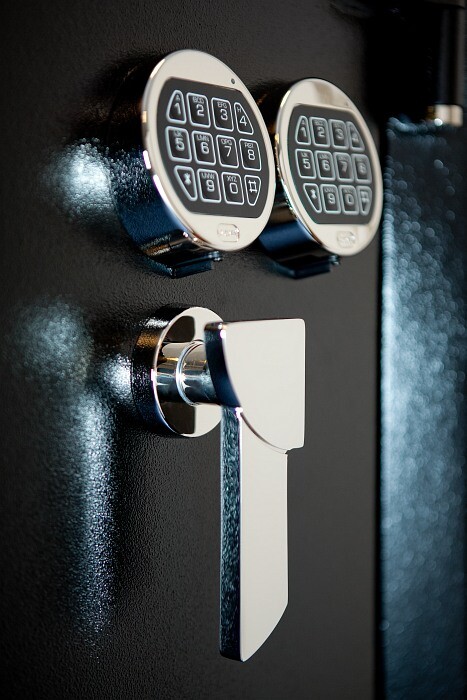
Electronic locks
Electronic locks – currently the most commonly used in home safes – provide a high level of security and offer simplicity and convenience of use thanks to:
● the ability to set your own alphanumeric code (digits, letters or a combination of both can be used to make it easier to remember the code, which must not be written down anywhere), allowing users to access the contents of the safe quickly and easily,
● alarm functions and the ability to audit operations,
● the opportunity to add several users (household members, colleagues),
● a time lock, which increases the level of protection against unauthorised access.
Innovative electronic locks in our offer, such as a biometric fingerprint lock or an electronic lock opened with a smartphone app, eliminate the risk of losing the key and relieve forgetful people of the need to remember the safe code.
These are modern solutions that increase not only the level of security, but also the comfort of using the safe significantly. A safe with an electronic lock is currently one of the most preferred solutions that we recommend at Hartmann Tresore when purchasing a safe, regardless of its burglar resistance class.
Mechanical combination locks
Mechanical combination locks are a reliable solution for those who value durability, security and ecology, and who are also meticulous and have good manual skills. Why? Because mechanical combination locks do not require a power supply or alkaline batteries, but they do require precision and time to open them. They are characterised by:
● exceptional durability,
● no need for power, making them the ideal choice in places with limited access to electricity,
● operation requiring some skill, which makes them more difficult to open quickly in a hurry.
Combination locks, widely known mainly from films such as Vabank or The Olsen Gang, are also considered very reliable. Today, the main character of Vabank, the likeable safecracker Henryk Kwinto, would not be able to open Gustaw Kramer's safe so quickly, because the dials of these locks rotate silently and are resistant to tampering without knowledge of the code. As a result, mechanical combination locks, especially 4-disc locks in security class ‘C’, are quite difficult to operate for inexperienced users, but they offer a relatively high level of security and are often used in places where there is no electricity, the safe is opened infrequently, and the risk of burglary is quite high.
What to store in a home safe?
It is a good idea to store all valuable items in a home safe, including documents, jewellery and money. Home safes can effectively protect these items not only from theft and damage, but also – an underrated aspect of having a safe at home – from loss. If you keep them in a safe and make it a habit, you will always know where they are. In addition, safes can be used to store data carriers, weapons, documents and other valuables that require special protection.
Documents
Storing documents in a safe protects them from loss, theft and damage and allows easy access to them when needed. Personal documents such as deeds, wills and important financial documents such as bills of exchange, shares, bonds and certificates of deposit should be protected in a safe.
A home safe also protects other important documents, including those of sentimental or historical value, such as letters, which could be stolen, destroyed or accidentally damaged. This ensures that all important papers are safe and always at hand when needed.
Jewellery
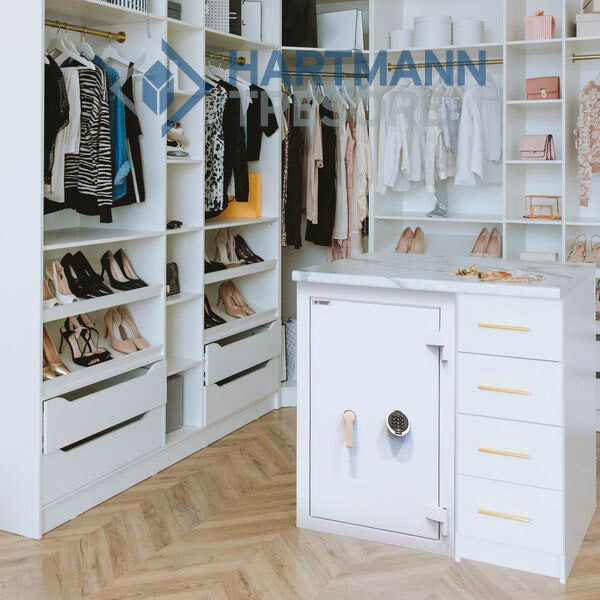
Jewellery is valuable items that require special protection because their value is transferred to the owner. Storing valuable jewellery in a home safe not only protects it from theft, but also from damage. This ensures that our high-value valuables are safe and always in perfect condition.
Eliminating the risk of losing jewellery and being able to store it in an organised manner is another advantage of keeping it in a safe. It is worth remembering that jewellery is not only vulnerable to theft, but can also be completely destroyed in a fire, so storing valuables in a fireproof safe will provide them with adequate protection: both against fire and theft.
Check out: The most interesting solutions in modern safes. What does the market offer?
Money
Storing cash, including foreign currencies, in a home safe is a great solution. It's like your own home ATM. It protects your savings from theft, the tax office and other threats. Home fireproof safes guarantee that your money will survive even the most difficult conditions, such as fire and water used to extinguish it.
Having a safe to store your money, a so-called strongbox, provides easy access to cash and protection from unauthorised persons. These safes come in different classes and sizes, and their purchase should be tailored to the value of the cash you intend to keep at home, otherwise you risk losing your accumulated funds easily (as in the article How not to lose 4 million zlotys)
So don't be surprised or offended if our advisor asks you about the maximum amount you plan to secure and insure in the safe. This is a question that every professional advisor should ask to avoid the risk of losing your money. At Hartmann Tresore, this information is treated as strictly confidential, is not recorded anywhere and is only reflected in the appropriate safe class and proposed additional security measures, which remain invisible to burglars. This makes it possible to perfectly match the class of home safes to the amount and value of the cash stored. We also raise the issue of trust here, because it is not only important what home safe you invest in, but also who you buy it from. The brand of the safe, its reputation and the experience behind it are not just empty marketing slogans, but a guarantee of the security of your funds.
Hartmann Tresore has been operating continuously for 132 years, and in Poland since 2002. Visit our showroom in Warsaw at Al. Jerozolimskie and see what we can do for your security. We have delivered tens of thousands of safes over the years. We never disappoint customers who have placed their trust in us – that's why they are happy to return for more safes.
Watches – men's jewellery
One of the most valuable items that men in particular keep in their safes – apart from collectible bottles of very expensive alcohol, of course – are designer watches with automatic mechanisms that require the use of watch winders to ‘wind’ their mechanisms when they are not being worn on the wrist. Watch winders are devices that prevent the deregulation of their expensive and complex mechanisms, thanks to which watches, even those worn occasionally – only on special occasions – always work like, nomen omen, a Swiss watch.
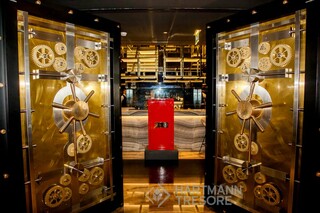
Collectible automatic watches from renowned brands, especially those from limited collections, are valued not in tens, but in hundreds of thousands or millions of euros. Their security requires the use of home safes, exceptional in this respect, that not only meet the highest security standards, but also provide an appropriate interior setting, including the use of watch winders, precious woods, and soft, prestigious materials for the interior finish of the safe. Such safes, like the watches stored in them, are true works of art. The brand Exquisite by Hartmann Tresore stands out here, combining uncompromising security with a prestigious, custom-made design that complements the elegance of your home's interior.
We also recommend the article: Watch safe
Fireproof safes not only for museums
We would like to draw special attention to the fire resistance or fireproofing of safes. Fireproof safes are essential equipment in every home where documents or other paper or magnetic media of value are stored. Paper is a medium of monetary value, so this also applies to cash. They protect the contents from high temperatures and flames, making them an important safety feature in the event of a fire. These safes are classified according to the length of time they can withstand a certain temperature without damaging the contents, which is usually between 1 and 2 hours. It is worth buying primarily fireproof safes manufactured in accordance with the PN-EN 1047-1 standard due to its stringent requirements that realistically reflect the conditions during a fire, its extinguishing and the burning of the ashes.
Most fireproof safes are equipped with thermal insulation, usually salt plates due to the very high boiling point of salt, which prevents heat from entering the safe, making it impossible to reach the temperature at which self-ignition occurs. Fireproof safes are available in various sizes and types, allowing them to be adapted to individual needs and storage conditions.
Although safes that offer double protection: fireproof and burglar-proof, are usually more expensive (prices for small fireproof safes start at around PLN 9,000), it is worth spending this money. The war in Ukraine and acts of sabotage in Poland show that starting a fire is one way of destabilising and causing damage. Shortly after the start of the war in Ukraine, Hartmann Tresore Polska delivered large fireproof cabinets for priceless manuscripts and book collections to the Ukrainian Stefanyk National Museum in Lviv and the Ossoliński National Museum, including as part of a donation.
Protection against burglary attempts
Protection against break-in attempts is one of the most important aspects to consider when choosing a home safe. Safes with high burglary resistance grades, starting from class II according to PN-EN 1143-1, are characterised by:
● a thick, multi-layer construction, which makes them difficult for thieves to break into,
● advanced locks that resist drilling attempts,
● a bolt locking system in case of a break-in.
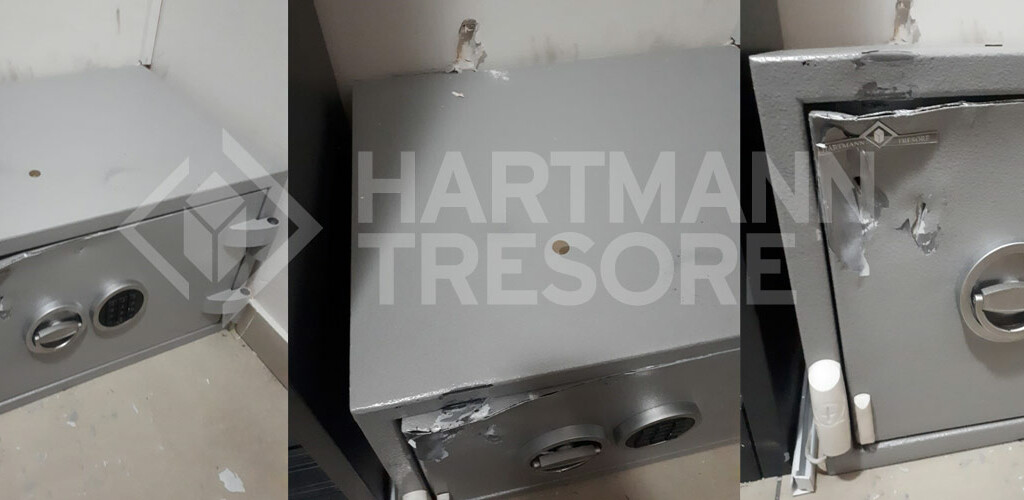
Safes of class II and higher are characterised not only by their durability, but also considerable weight, which makes them difficult to remove from the house (thieves usually steal safes with their contents, as opening them on site is too risky due to the noise and time involved). In addition, the four-sided locking of the safe door and the bolt safety system used in the door increase security and prevent the door from being opened if the external hinges are cut or attempts are made to drill open the lock. The sensors and electronic locks used in Hartmann Tresore home safes allow connection to alarm systems, which increases the level of security – some locks can be equipped with an opening delay function and a so-called silent alarm, i.e. opening the safe which allows to send an alarm signal about a break-in to a security company without any external signs and exposing the household members to danger.
Last but not least – anchoring your home safe
Finally, remember that safes weighing less than 1,000 kg should be anchored to the building structure to ensure their stability and security. Why? Because the anchoring force expressed in 20, 30 or 50 kN, as in the case of class safes, acts as if the safe weighed 2 to 5 tonnes more. This means that, taking the weight of the safe itself and the anchoring force of 50 kN into account, a correspondingly greater force must be used to detach it, which is impossible without the use of specialised equipment. To illustrate this in practical terms, a large forklift truck with a lifting capacity of more than 5 tonnes would be needed to steal such a safe!
The cost of a home safe
The cost of a home safe can vary and depends on many factors, such as size, material and additional security features. Prices for home safes can start at around 5,000 PLN for simple models and reach up to 450,000 PLN for advanced, functional devices. Solid, heavy home safes can be purchased for as little as a several thousand zloty.
It is worth remembering that buying a home safe is not only an expense, but above all a way to protect our valuable items and savings. A well-chosen product from our range or other available sources will provide peace of mind and security for many years to come.
Summary
In summary, home safes are an indispensable tool in protecting our valuables from theft, fire and other threats. Choosing the right safe is complicated and requires consideration of many important factors, such as the type of threats, the resistance class of the safe, the material it is made of, its intended use, location and method of installation. Home safes significantly increase the level of security and improve the safety and comfort of the owner's life, especially when they are away from home.
Investing in a home safe is a step towards ensuring the safety of our valuable items and savings. Whether we store documents, jewellery or cash, a properly selected safe gives us peace of mind and confidence that our property is secured.
Frequently asked questions (FAQ)
Does a home safe make sense?
A home safe makes sense as a secure place to store valuables such as cash, jewellery and other valuable items. It is strongly recommended to avoid keeping them in plain sight or in easily accessible places.
What is the best safe for home?
The best safes for home are models from reputable manufacturers, such as Hartmann Tresore, which are characterised by high quality and security-enhancing features. Choosing such a safe will ensure adequate protection for your valuables.
What types of home safes are available on the market?
There are free-standing safes, wall and floor safes available on the market, which differ in terms of security levels and placement options. The choice of the right safe should be tailored to the individual needs of the user.
What are the most important features of electronic locks in home safes?
The most important features of electronic locks in home safes are a high level of security, convenience of use and the opportunity to manage access remotely. Alarm functions also increase protection.
What is worth storing in a home safe?
It is worth storing documents, jewellery, money and data storage devices in a home safe to ensure maximum security. This is crucial to protect your valuables from theft and loss.