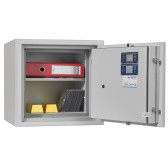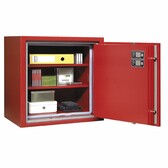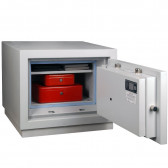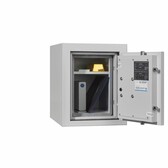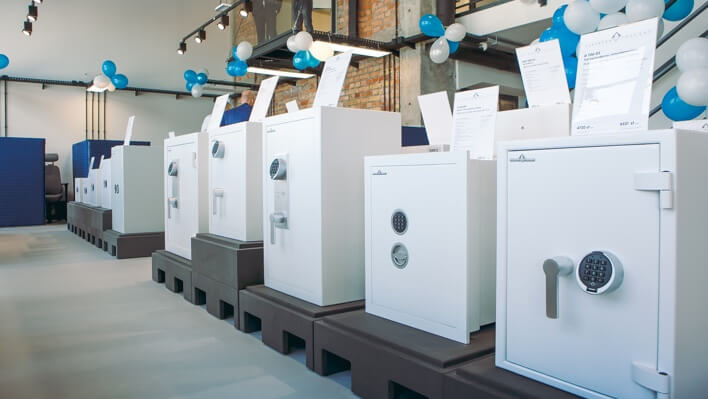
Times are tough, bad and dangerous, with evil and doom waiting around every corner, yet every year thousands of us build homes or buy flats. After all, the apocalypse is the apocalypse, but best at home. As the cyclical trade fairs of the construction industry, or even the finishing industry (such as the Warsaw Home trade fair, which we attend regularly) show, interest is not waning and property owners are more and more willing to opt for houses and flats equipped with various elements, from ecological accents through Smart-Home infrastructure to the security of the building itself and the items inside. And this is where we, all in steel and concrete, come in, because with the increasing affluence of Poles combined with a growing belief in the inevitability of a global catastrophe, there is a growing interest in safes right from the initial property design stage. Let's see.
What do you need a home safe for?
A home safe allows you to secure stored items in an effective way, so that they remain intact in the event of a break-in. Instinctively, a home safe is associated with spectacular possessions, but this need not be the case.
A safe is not just a place to store cash and jewellery. There are many other valuables that are worth putting in there to keep them safe and protected from theft, fire or other threats.
Valuable items for which it is worth investing in a home safe can be divided into several categories:
Documents:
• deeds, land records, wills;
• contracts and other important legal documents;
• passports, identity cards, driving licences;
• birth, marriage and death certificates;
• insurance policies;
• bank statements and other financial documents.
Items of value:
• jewellery, watches, precious stones;
• works of art, antiques, collectibles;
• electronic equipment, e.g. laptops, tablets, hard drives;
• data carriers, e.g. memory sticks, memory cards;
• money in cash.
Other items:
• spare keys for home, car and other places;
• firearms and ammunition (in accordance with current legislation);
• medicines and controlled substances;
• souvenirs and other items of sentimental value.
Which home safe to choose?
Choosing the right safe for your home depends on several factors, such as:
Capacity:
• How many items do you want to store in the safe?
• What are their sizes?
The answer to this question will not only allow you to choose the protection to suit the size of your valuables, but will help you determine an equally important consideration – where this home safe will be installed and how much space you need for it. When choosing a home safe, you will have a choice of models of different sizes and you are sure to find something suitable.
Security class:
• What kind of burglary protection do you need?
• Home safes are classified on a scale of I to V, where I stands for the lowest and V for the highest burglary resistance.
A home safe is quite often associated with a device of compact size and low weight. While lightweight and small home safes do exist, it is important to be aware that they are not suitable for storing valuables and have little resistance to mechanical damage involving break-ins.
The security of a safe consists of two (sometimes three, but more on that in a moment) elements:
• the aforementioned security class, which is the degree of complexity of the construction based on the European Standard EN 1143-1. The higher, the better. But why? Thanks to its robust construction, a home safe is more resistant to mechanical damage, drilling, cutting. In view of this, in order to get inside the safe, a burglar will have to work hard, this requires time, which this person does not have, and the use of specialised tools. Put simply, it cannot be done on the spot.
As the level of security increases, so does the whole structure, not only the thickness of the door and body, but also the increasingly sturdy bolts, which will allow an effective protection against burglary with a crowbar.
• From the class of the safe comes factor No. 2 – the weight of the safe. Since a safe made of high quality materials and in a high grade cannot be forced through on the march, one has to take it with them. However, this is not so easy for an item weighing several hundred kilograms, additionally permanently mounted to the floor and/or wall.
We have a range of small home safes that weigh more than 100 kg. The larger the home safe, the heavier it will be and therefore the risk of unexpected loss of valuables will decrease.
Lock type:
• Safes can be fitted with key, mechanical, electronic or biometric combination locks.
• Electronic and biometric locks are usually more convenient to use.
Characteristics
The basic type of lock is a key lock, where two keys are included. The type of lock does not affect the level of security of the safe, but allows you to tailor the daily operation of the safe according to your needs.
The mechanical cipher lock is a slightly extravagant solution where the customer likes classic, even 'old-school' solutions. The cipher is entered by turning the knob in both directions. Traditional mechanical combination locks have their charm, but require precision and patience.
The electronic lock is the most popular, as it allows convenient access to the safe via a pin code, usually 6 digits. Advanced electronic locks allow operations to be audited, which is important for the business use of an armoured locker.
The biometric lock, on the other hand, is a solution that provides security and convenience, but due to the price of the device itself is more suited to larger and more expensive home safes.
Many of the articles on our blog deal specifically with safe locks. We encourage you to read, for example: Overview of popular locks in safes.
Additional features
A separate feature of home safes, which ensures the comfort of storing documents or cash, is fire resistance.
We have a range of home safes that are fire resistant from 30 to 120 minutes, so if you want to protect yourself from the unexpected loss of documents such as securities, deeds, documents containing sensitive data or cash, protect yourself from fire as well.
If you want to further strengthen the security of your stored items, there is also the option of equipping the safe with burglar alarms, which you can then connect to your home installation.
Mounting
The correct installation of a safe is crucial. As a rule, a home safe is placed in the most intimate place, in a dressing room or wardrobe or, if you have such a room, in a study.
It is crucial that home safes are installed in accordance with the art, i.e. anchored to a structural element of the building, floor and/or wall. We offer such a service; it is worth taking advantage of.
Summary
When planning the design and furnishing of your new house or flat, you take all possible aspects of the case into account, the layout of the rooms, the furniture.... At this point, it is worth investing in placing a safe in your personal space, a device in which you lock all the treasures you have, documents, valuables, jewellery and family heirlooms with a conventional key.
We offer products that will provide you with optimum protection; you will find home safes to suit your needs, from small compact safes to quite large armoured safes.
Please do not hesitate to contact our sales department, who will be happy to give you professional advice on your choice.